An AI agent that finds the public tenders worth bidding on
Every morning it reads hundreds of Polish and EU tender notices, scores each one against the company's profile and brings back only the few worth opening. The rest happens in a panel where the team takes a tender from “we noticed it” to “we won it”. The idea, the automation, the backend, the app and the whole UI: I did all of it myself.
Project
My own product for companies that live on public procurement
My role
Idea, automation, backend, app and the entire UI design
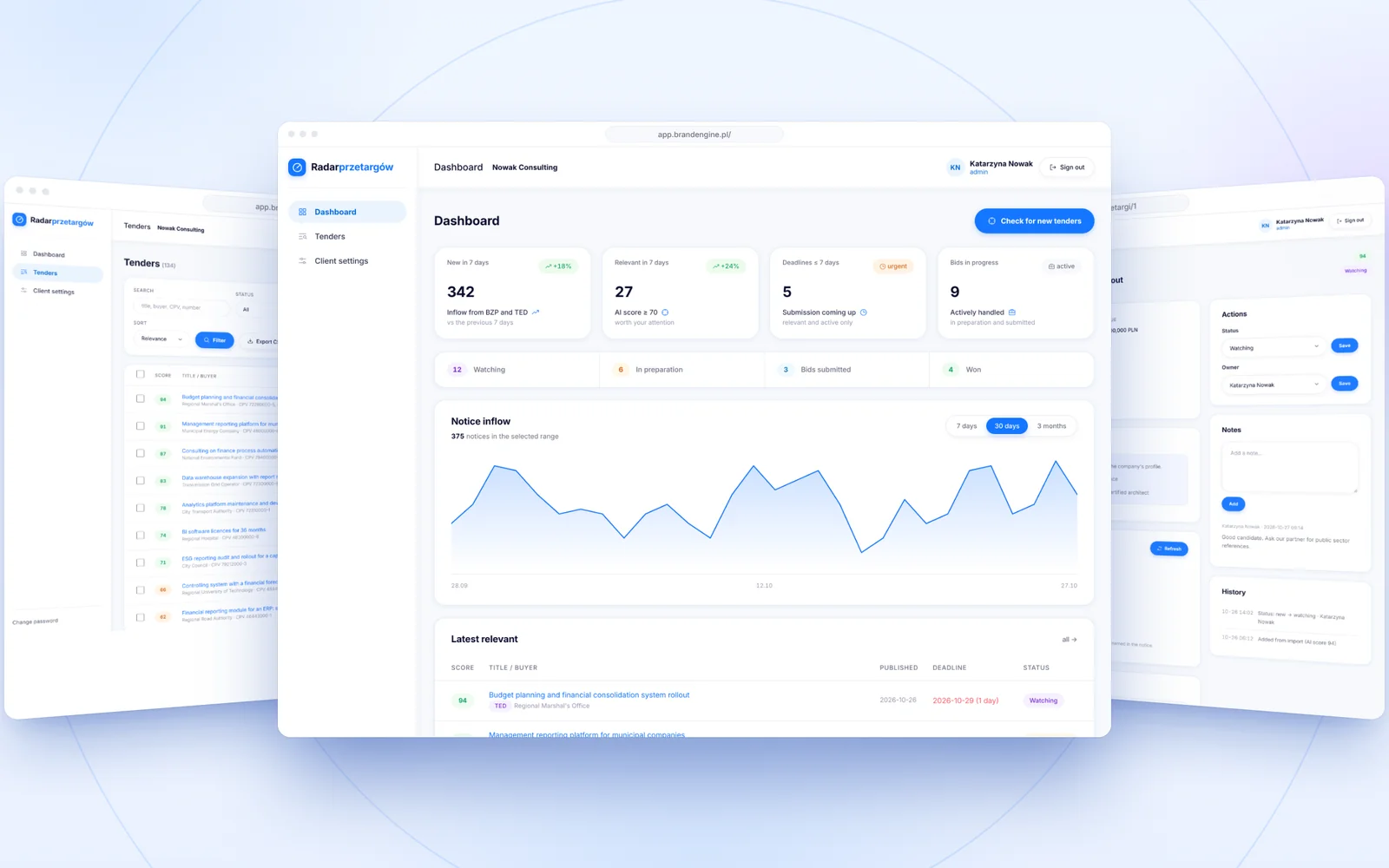
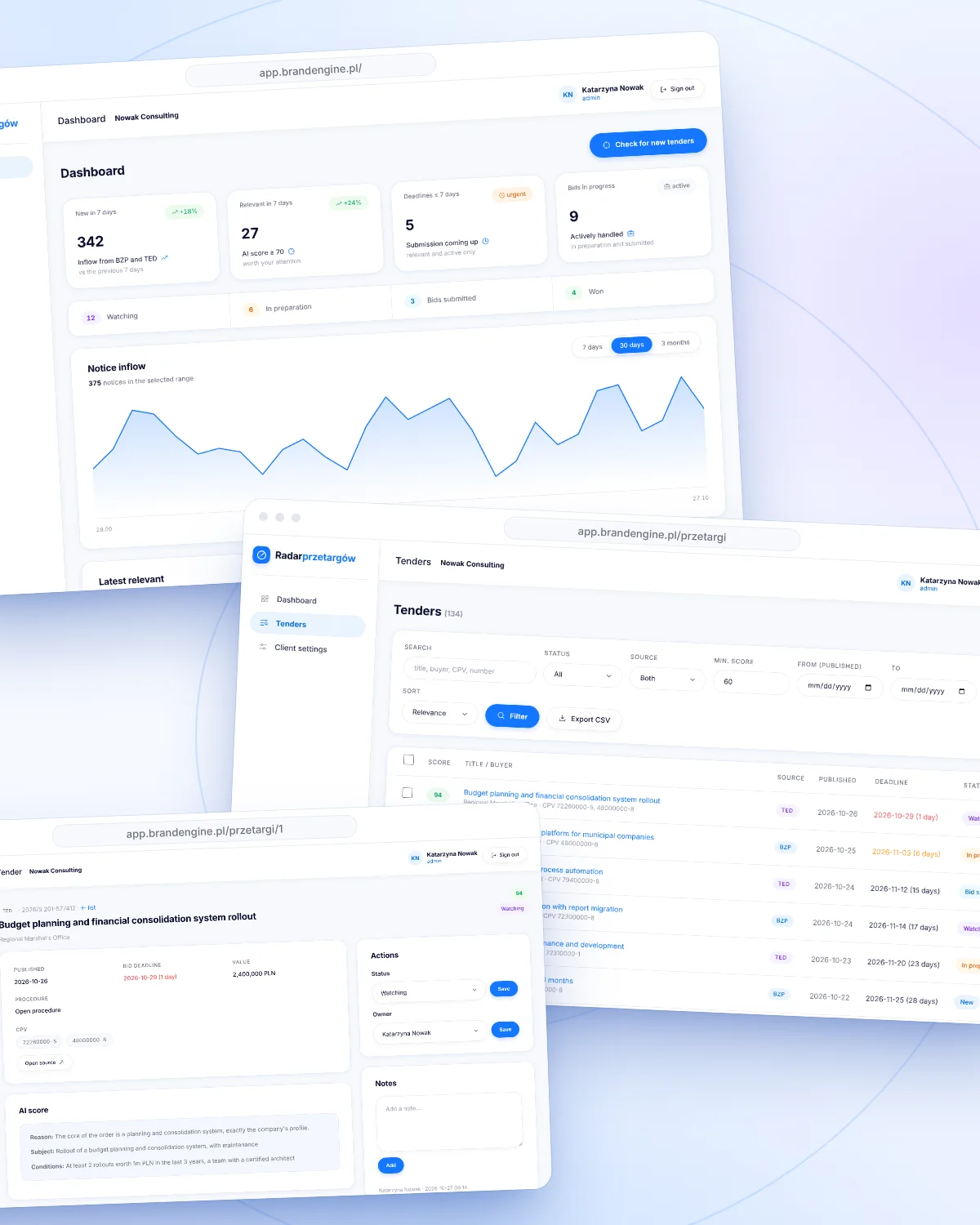
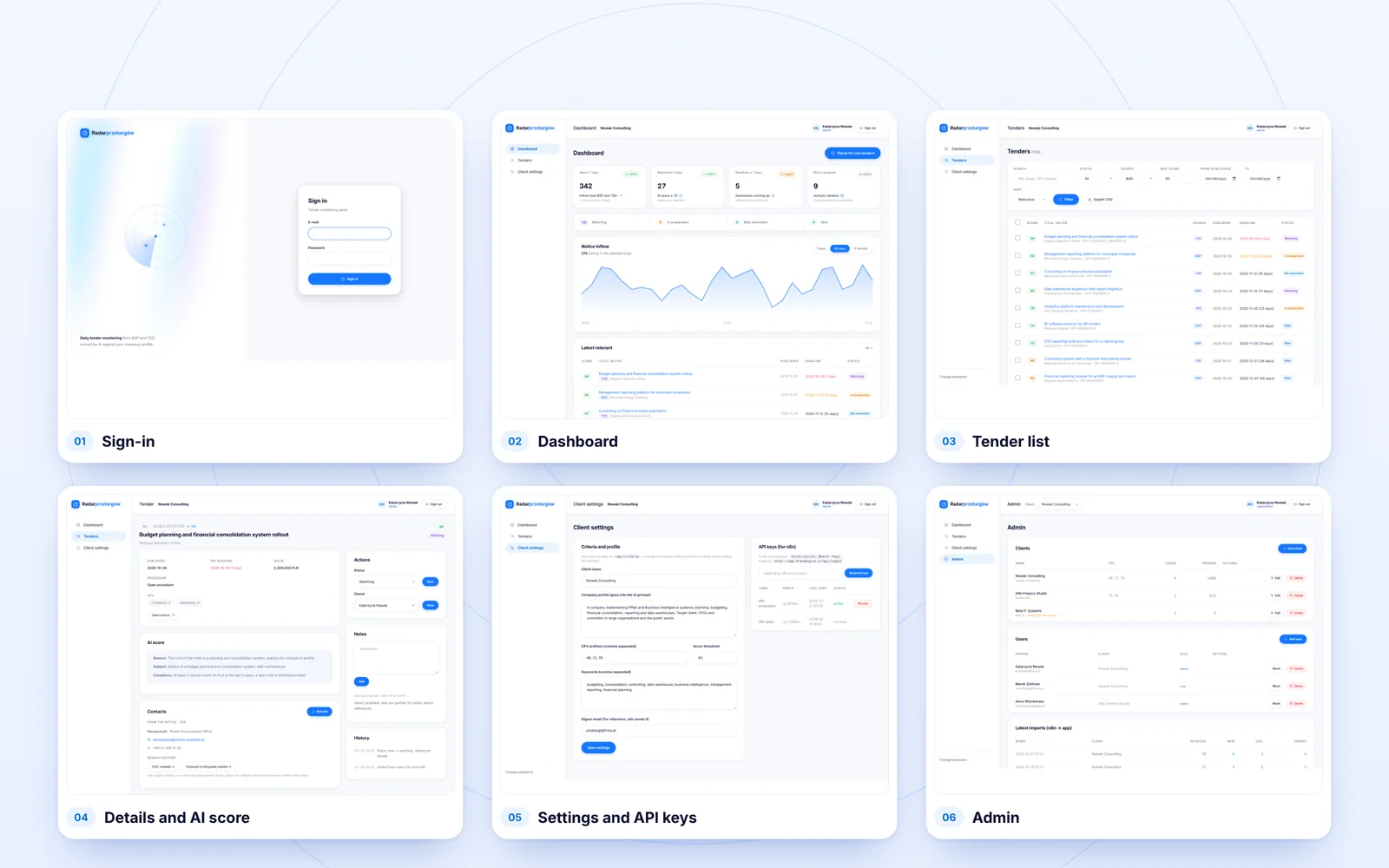
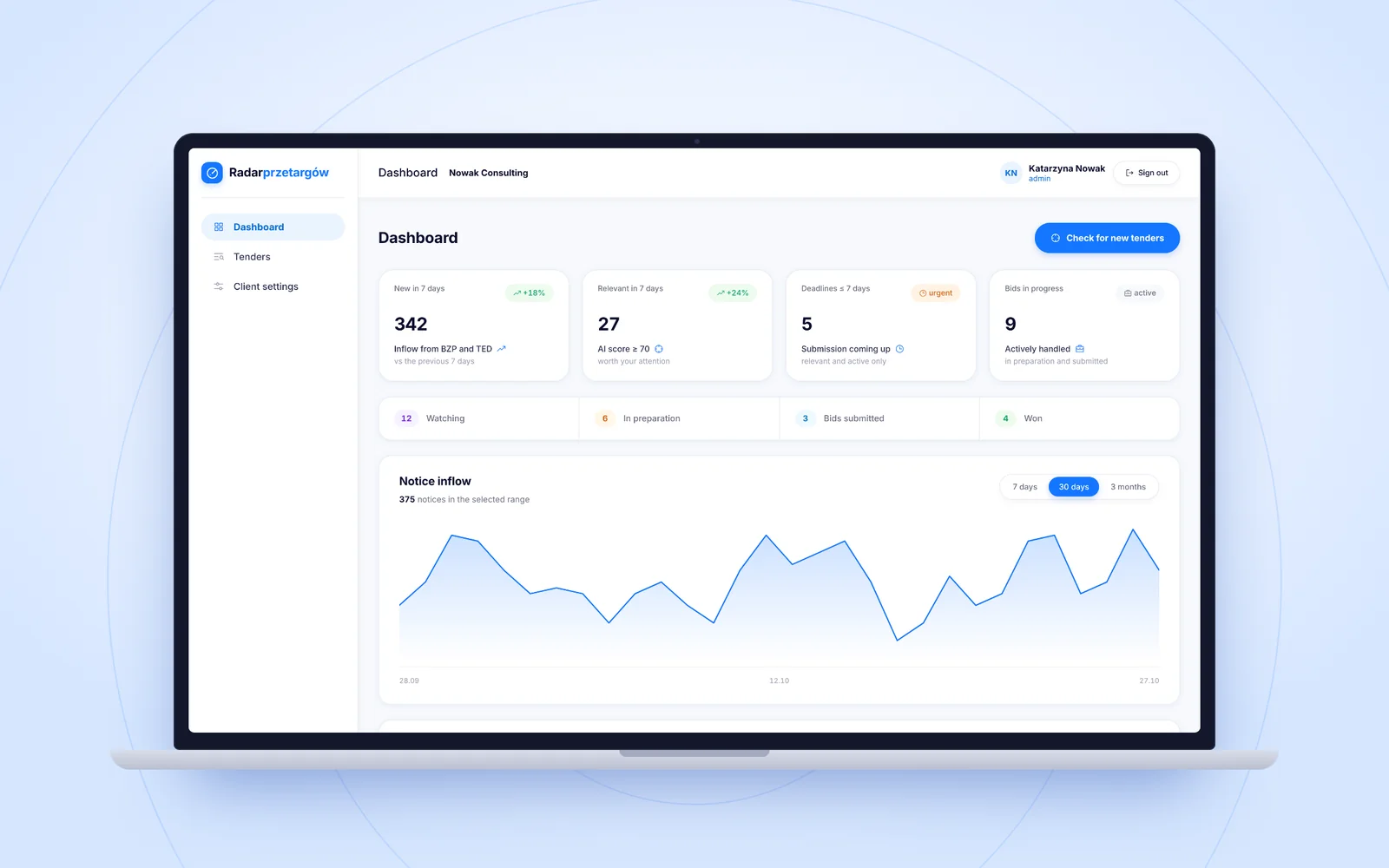
The dashboard, the tender list and the tender detailsScreens translated into English for this page
300–700new notices a day in BZP alone, plus TED
~78notices a day left for AI to score after the filter
~6¢to score every notice from one run
7:00every morning, with nobody pressing a button
The problem
Tenders are public, but they get lost in the noise
Companies that live on public contracts all share one problem. Polish BZP publishes 300 to 700 notices a day, and the EU's TED adds more on top. Someone has to read them every day and decide whether any of them makes sense for the company.
I saw this problem up close and decided to close it with one tool: an agent that reads the notices instead of a person, judges the fit and brings only the ones worth opening.
✕Boring, repetitive workHundreds of notices a day, read by hand, almost all of them irrelevant.
✕One miss is one lost contractA single overlooked notice can mean a contract that went to someone else.
✕Nowhere to keep the workA tender read in the morning is forgotten by the afternoon unless it lands somewhere.
How it works in short
One n8n workflow does the reading. A language model does the judging. People only see what passed, and pick it up in the panel.
n8nautomation, rules and plumbingAIreading and scoringTeamdecisions in the panel
The agent doesn't decide what to bid on. It decides what's worth a person's five minutes.
Step by step
01 / 05n8n
From hundreds of notices to a handful
At 7:00 the workflow pulls fresh notices from both sources. Most of them are thrown out before AI ever sees them: CPV codes and multi-word industry phrases cut the noise, and de-duplication makes sure nothing returns twice.
Only what survives the filter is sent to the model. That's why scoring a whole run costs about 6 cents.
Schedule
Every day at 7:00, plus a manual refresh in the panel
Filter
CPV codes and multi-word industry phrases
Data
Open APIs of TED and e-Zamówienia (BZP)
One morning runsimulation · one dot is one notice
0 notices read
0 scored by AI
0 worth opening
300–700 a daynotices in BZP, plus TED
~78 a dayleft after CPV codes, phrases and de-duplication
a few a monthreal hits above the threshold, for a narrow industry
02 / 05AI
The prompt is the heart of the agent
I don't ask the model “is this interesting?”. It gets the role of a tender analyst, the company profile, the full notice and a strict JSON answer format: relevance, a one-sentence reason, subject, buyer, value, deadline and conditions for taking part.
Two lines were added after testing on real data. TED's search is fuzzy and can return medicines or buses, so the model is told to score unrelated notices low without hesitation. And because descriptions are often vague (“details in the specification”), I paste in fragments of the full document around the keywords and tell the model to look for evidence there.
Model
gpt-4.1-mini, called from the workflow
Parser
Works with other models too, so a swap needs no code change
Cost
About 6 cents per run
Anatomy of the promptsimplified · point at a layer
You are a public tender analyst.1Company profile: what it does, who its clients are, what it never sells.2Notice: the full title, description, CPV codes, buyer, value and deadline.3Fragments of the specification around the keywords. Look for evidence here.4Score 0–100 on the graded scale. If there is no connection, score low without hesitation.5Answer only in JSON: relevance, reason, subject, buyer, value, deadline, conditions.6
1Role. An analyst, not a chatbot.
2Profile. Different for every client in the panel.
3The notice. The part that changes every time.
4Evidence. Added after vague descriptions fooled the model.
5Scale and rule. Added after TED returned buses.
6Strict format. So the panel can read every answer.
answer.json · sample data
{
  "relevance": 94,
  "reason": "The core of the order is a budgeting and
    consolidation system, exactly the company's offer.",
  "subject": "Budget planning system: supply and rollout",
  "buyer": "Regional Marshal's Office",
  "value": "≈ 2.4m PLN",
  "deadline": "29 Oct, 10:00",
  "conditions": "Two similar rollouts in the last 3 years"
}
03 / 05AI
A graded scale instead of yes or no
The first version of the scale was all or nothing, and it produced a gap: everything was either very high or close to zero. There was no way to tell a perfect match from a tender where the company could only join as a subcontractor.
I rewrote it into five bands. Now the score says how close a notice is to what the company actually does, and the threshold of 60 sits in a place that means something.
Threshold
60 by default, set per client
Above
Goes to the panel and the morning email
Below
Kept, but nobody is bothered with it
The five bandspoint at a band
80–100. The core of the order is exactly what the company does.
v1 · yes or noeverything at the edges
0100
v2 · five bandsa score that tells cases apart
0100
Score distributions are illustrative.
3 of 10 sample notices reach the morning email
94Budget planning system: supply and rolloutBZP
87Consulting on finance process automationTED
66Data warehouse expansion with a reporting moduleTED
52Hospital ERP with a required controlling moduleBZP
41City management system, analytics as one of many modulesBZP
27IT services where “reporting” appears in the conditionsBZP
15Security operations centre for a ministryTED
9Boxed office software licencesBZP
4Supply of laptops and monitorsBZP
1Supply of city busesTED
04 / 05Team
A panel where tenders don't get lost
Reading is only half of the job. In the panel the team watches a tender, prepares the bid, writes notes and marks the result, so nothing disappears after the morning email.
DashboardNew and relevant notices with a week-on-week trend, upcoming deadlines, an inflow chart for 7 days, 30 days or 3 months.
PipelineWatching, in preparation, bid submitted, won.
DetailsThe AI score with its reason, conditions, deadline, team notes and history of changes.
ContactsPulled straight from the notice, with searches for decision makers prepared. It never makes up names.
Many clientsOne panel, several companies, each with its own profile, threshold and API key.
Backend
PHP 8.2 with no framework, MySQL, server-rendered views
Access
Logins, roles, multi-tenant, API keys for data from n8n
Hosting
Plain shared hosting, no containers, no costly infrastructure
Try the details I cared aboutrebuilt for this page
Found 3 new relevant tendersTop AI score: 94. Refreshing the dashboard.
Dashboard, list and details: the biggest thing on screen is always the number that decides the working day.
05 / 05Me
A UI designed from the logo to the last status pill
The brief to myself was simple: light, readable at first glance and nothing like the grey admin panels procurement systems got us used to.
I went through several iterations: from a dark navigation, through a layout on a warm background, to today's light version. Every change came from looking at real data in a real view, not at mock-ups.
Type
Inter, self-hosted. One family, three weights.
Shapes
Large radii, pills instead of rectangles
Mobile
Navigation turns into a horizontal icon bar
The visual languagepoint and compare
One geometric radar. The same mark in the logo, the card icon and the animated login screen.
Click a colour to copy its HEX.
Statuses always come in pairsA pastel background with saturated text, so a status reads without looking closely.
WatchingIn preparationBid submittedWonurgent94
27a black shadowheavy, like a form
27a blue-tinted shadowthis is what makes it light
1Dark navigation
2Warm background
3Light, today
What took some figuring out
None of this was in the documentation. Each lesson came from running the agent on real data and watching where it broke.
1Source
BZP alone is not enough
I checked it empirically: the BZP endpoint only returns orders below EU thresholds. Large rollouts exceed them, so they live in TED.
12,525notices in 30 days of BZP0hits for large rollouts
TED became the main source, BZP stayed for smaller orders.
2API
“OR” returns less, not more
In TED a query with “OR” gives fewer results than a single phrase. Short acronyms bring junk.
phrase A OR phrase Bphrase Aphrase B
One phrase is one query, multi-word phrases only, results merged by notice number.
3API
Paging that is ignored
BZP ignores the paging parameter, and one day has more notices than a page holds.
one day of noticesnewest first →← oldest firstoverlap ✓
Each day is fetched twice, from both ends, and a node checks that the ranges overlap.
4Memory
20 MB that took the instance down
n8n stores the output of every node. A raw day of BZP is about 20 MB, which crashed the instance on the first run.
~20 MB before~640 kB after
Fetching and filtering now happen in one node, so only the small part flows on.
The last lesson wasn't technical. For a narrow industry there are a few real hits a month, not a few a day. An empty morning email is normal, not a failure. I built the tool to tell the truth, not to look busy.
What came of it
Two sources read automatically every morning, about 78 notices a day scored for around 6 cents a run, and one place where the team takes a tender from the first signal to the result.
There was no one else's brief and no compromise halfway. I was the client, the user and the designer at once, so I could polish details nobody would normally ask about, and keep in the view only what really helps.
Make AI do one job
The model reads and scores. Everything that can be a rule (filters, duplicates, thresholds) is plain automation.
Test on real data
The evidence fragments, the “score low without hesitation” rule and TED as the main source all came from real runs.
Tell the truth
An empty email is an answer too. A tool that invents activity loses trust fast.
Is your team reading hundreds of things to find the three that matter?
Tell me where the noise is. I'll design an agent that reads it for you, and a clear view to act on what it finds.